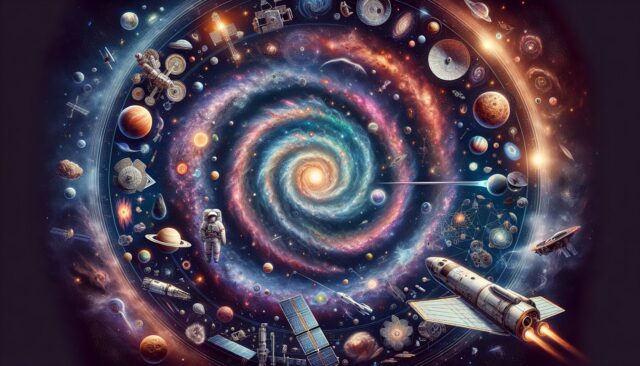
As a child, did you ever gaze at the night sky from your bedroom window before bed, it’s vastness filled with twinkling stars and the glowing moon? Did you ever lay in the grass on a warm summer night, staring up at the inky blackness with the milky streak of our galaxy cutting across the sky, wondering what was out there? Our universe is a fascinating place – a mysterious realm of celestial bodies and cosmic phenomena. Just like a life journey, the exploration of the universe has been filled with great discoveries and immense challenges.
The Big Picture: What Is the Universe?
The universe, in simplest terms, is all the matter, energy, and space that exists. It encompasses everything from the tiniest particles to the largest galaxies, from the weakest forces to the strongest energies. Scientists estimate that the universe is around 13.8 billion years old, originating from an event known as the Big Bang.
Life Journey through The Universe: Timeline of Discoveries
Our human journey of exploring the universe is not unlike any life adventure, with its own ups and downs, twists, turns, and unexpected surprises. Starting with ancient civilizations, who studied the stars and planets with humble instruments, to the modern era with our high-powered telescopes and spacecrafts, a timeline of our discoveries can look something like this:
-
Early Astronomy: The first astronomers used simple tools to study the night sky, noticing patterns and beginning to unlock the secrets of the universe.
-
Copernican Revolution: In the mid-16th century, Polish astronomer Nicolaus Copernicus proposed that Earth is not the center of the universe, but rather, the sun is. This revolutionary idea led to the development of the heliocentric model of the universe.
-
Galileo’s Discoveries: Galileo Galilei improved the telescope and made numerous important discoveries in the early 17th century, including the moons of Jupiter and the phases of Venus.
-
Einstein’s Theory of Relativity: Albert Einstein’s general theory of relativity radically transformed our concept of space and time in the early 20th century.
-
Expansion of the Universe: Edwin Hubble discovered that galaxies are moving away from us in the 1920s, implying that the universe is expanding—a major piece of evidence confirming the Big Bang theory.
-
Cosmic Microwave Background: In 1965, Arno Penzias and Robert Wilson discovered the cosmic microwave background radiation, which is thought to be leftover heat from the Big Bang.
-
Dark Matter and Dark Energy: In the last century, astronomers discovered that most of the universe is made up of unknown substances called dark matter and dark energy, puzzling mysteries that continue to push the boundaries of scientific understanding.
Just like a life journey, each discovery has led us closer to a better understanding of the universe and our place in it and made us aware of how much more there is left to explore and understand.
Down the Rabbit Hole: The Universe’s Mysteries
The universe is not all about stars and galaxies, it’s also full of incredible phenomena that push the boundaries of our understanding. These include:
-
Black Holes: Supermassive black holes are mysterious celestial bodies that possess extremely strong gravitational forces.
-
Dark Matter and Dark Energy: These invisible substances can’t be directly detected, but their effects can be seen in how galaxies rotate and how the universe expands.
-
Multiverse: It’s possible that our universe is not the only one. There could be countless other universes out there – an idea known as the multiverse theory.
These mysteries make the scientific journey to understanding the universe such a thrilling life adventure!
Conclusion: The Ongoing Adventure
Like any bold journey or adventure, our quest to understand the universe is a path paved with challenges, the thrill of discovery, and the joy of knowledge. It’s an adventure that requires us to push our boundaries, face our limitations, and boldly explore the unknown – much like our own life journeys.
The universe is not just about far-off stars and galaxies; it’s also about us. Studying the universe tells us about our origins, our planet, and potentially, our future. Each new discovery reshapes our perspective, teaching us humility in the face of the vast cosmos and serving as a constant reminder of our shared cosmic heritage and destiny.
So, as you gaze at the night sky, remember: you’re not just looking at stars or galaxies; you’re witnessing the cosmic story – the thrilling adventure that we’re all part of – unfolding across the expanse of the universe.