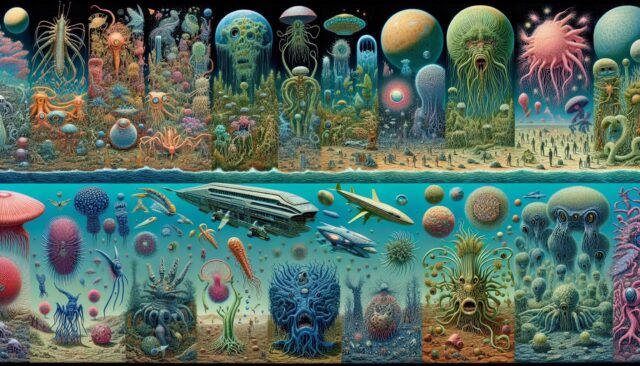
As humans continue to explore the vastness of space, the question of whether or not we are alone in the universe remains one of the most intriguing mysteries. Scientists and researchers have put forth various theories about the possibility of life on other planets, each offering new insights into what could be lurking beyond our own cosmic backyard.
One of the most well-known theories about life on other planets is the concept of exoplanets – planets that exist outside of our solar system. With the discovery of thousands of exoplanets in recent years, scientists have speculated that some of these distant worlds could potentially harbor life. The presence of liquid water, an essential component for life as we know it, on some of these exoplanets has further fueled this speculation.
Another theory about life on other planets involves the concept of extremophiles – organisms that can thrive in extreme environments. On Earth, extremophiles have been found in some of the harshest conditions, such as deep-sea hydrothermal vents or acidic hot springs. Scientists believe that if life can exist in such extreme environments on our own planet, it is possible that similar organisms could exist on other planets with similar conditions.
The search for life on other planets has also led to the exploration of Mars, our closest planetary neighbor. Over the years, Mars rovers have uncovered evidence of past water on the red planet, raising the possibility that microbial life may have once existed there. While no conclusive evidence of current life on Mars has been found, ongoing missions continue to search for signs of past or present life on the planet.
In addition to Mars, moons in our own solar system have also garnered interest as potential hosts for extraterrestrial life. Europa, one of Jupiter’s moons, is believed to have a subsurface ocean that could potentially support microbial life. Similarly, Enceladus, one of Saturn’s moons, has geysers that spew water vapor into space, hinting at the possibility of a subsurface ocean teeming with life.
Beyond our own solar system, the search for extraterrestrial life has extended to distant stars and galaxies. Scientists have proposed the concept of panspermia, the idea that life could have been transported between planets, moons, and even star systems by comets, asteroids, or other celestial bodies. This theory suggests that life could exist in unexpected places throughout the universe, waiting to be discovered.
As humans continue to push the boundaries of space exploration, the search for life on other planets remains a central focus of scientific inquiry. Through advancements in technology and the development of new instruments and techniques, researchers are able to probe deeper into the cosmos than ever before, opening up new possibilities for discovering extraterrestrial life.
While the search for life on other planets is still ongoing, the theories and possibilities that have been put forth by scientists offer a glimpse into the potential diversity and complexity of life in the universe. Whether it be through the discovery of microbial organisms on Mars or the detection of biosignatures on distant exoplanets, the quest to unravel the mysteries of life beyond Earth continues to captivate and inspire those with a passion for space exploration.
In conclusion, the exploration of the cosmos and the search for life on other planets are at the forefront of scientific discovery. As humans continue to unravel the mysteries of the universe, the possibilities for finding extraterrestrial life are endless. Whether it be through the study of exoplanets, the search for extremophiles, or the exploration of our own solar system and beyond, the quest for understanding our place in the cosmos is a journey that will continue to inspire generations to come.